General strike in Spain on 11 November: trains, airports, schools and doctors in Valencia, Alicante and Benidorm
A 24-hour general strike has been called in Spain for Wednesday 11 November, the first involving CCOO and UGT since 2012. We look back at how the country came to a halt in 1988 and 2012, and set out what is already confirmed for Valencia, Alicante and Benidorm: trains, airports, schools, doctors, workers’ rights and what business owners must do.

On Wednesday 11 November 2026, CCOO and UGT are once again calling on the country to stop for a day. If you have a train ticket for next week, look at three days at once: Renfe train drivers walk out for 24 hours on 10 November, the general strike runs on 11 November, and the drivers have more partial stoppages planned for 12 November. Renfe is already offering free refunds or ticket changes.
We checked this article on 3 November. On that day there were still no timetables for 11 November from Renfe, Metrovalencia or the TRAM in Alicante and Benidorm. The authorities usually publish them a few days before a strike. Below is what is already confirmed, and where the figures will appear.
In this article
What has been called for 11 November
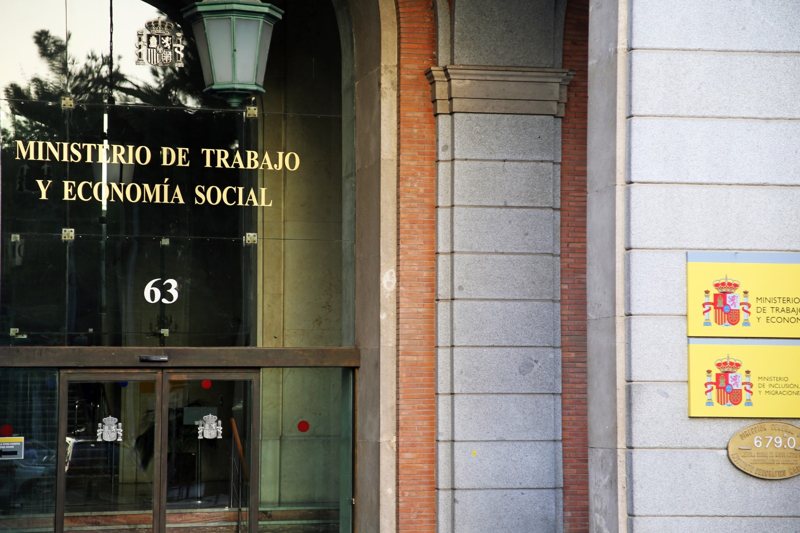
CCOO and UGT, the two biggest unions in Spain, announced the strike on 7 October. On 19 October they filed the paperwork with the Ministry of Labour, together with CGT, CNT, Intersindical, CO.BAS, the actors’ union and the confederation of tenants’ unions. The strike lasts 24 hours, from 00:00 to 23:59 according to CCOO.
The strike has been called nationwide, but how many people actually stop work will only be known on the day. The CSIF union is not taking part. The employers’ confederation CEOE and the People’s Party (Partido Popular, PP) call the strike political: the general election is on 29 November and the campaign starts on the 13th. The organisers in Valencia reply that its causes are social.
Why they are striking
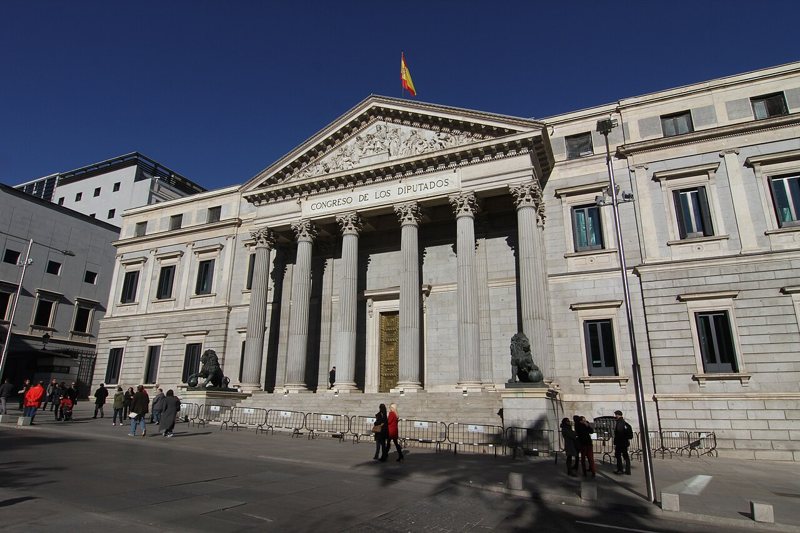
Several grievances have built up. Congress rejected two government decrees on housing. In Madrid an 87-year-old woman was evicted, and after that people took to the streets banging pots and pans. UGT adds its own figures: according to provisional data from the INE, the national statistics institute, prices rose 4.9% year on year in October, while pay under collective agreements has gone up 3.05% since the start of the year.
The unions want to limit rent rises, see more public housing built, raise wages and shorten the working day. UGT is asking for the minimum wage to rise by at least 7% in 2027. In Valencia the talk is mostly about housing costs. Sindicat de Llogateres, the tenants’ union, says rent takes half a salary, and a CGT representative puts it at 70%. These are their own estimates.
How it went before: the big strikes of 1988 and 2012
14 December 1988. The country struck against a youth employment plan and the Socialist government’s economic policy. The unions spoke of about 90% of workers, the government counted around 30% and the employers 26%. A writer at Valencia Plaza remembers his journey to work in Madrid: more than an hour on foot, because public transport had stopped. El Corte Inglés was the only big store that opened, and during the day pickets threw pesetas at shoppers by its entrance on Calle Princesa.
The employment plan was shelved. In 1989 pensions were linked to inflation and civil servants got a pay rise. None of this stopped the same party: it won the election again in 1989.

29 March 2012. The country struck against a labour reform. Long-distance AVE trains ran a minimum service of 20% of a normal day. Flights from mainland Spain to countries in the European Economic Area also kept 20%, and flights outside it 40%.
14 November 2012. The last time CCOO and UGT struck together across the whole country. The same day looked very different depending on who you asked: the unions said 77% and 9.1 million people, the employers 12%. In the morning electricity use was 11.4% below forecast, according to the Interior Ministry. Around 400 flights were cancelled, transport ran a compulsory minimum service, car factories came to a halt, and shops struck far less. CCOO counted more than a million people at the march in Madrid.
In Valencia that day the unions reported 95% of staff out at the Generalitat Valenciana’s (regional government’s) railways and 100% at EMT. The Ford plant in Almussafes and the Vossloh train factory stopped, and many schools and universities closed. There were far fewer cars on the roads. Shops in the centre opened as usual in the morning. Pickets went mainly to El Corte Inglés and Bankia branches, where there was graffiti and eggs were thrown. The Generalitat put the fall in electricity use at 3%, and the employers’ association Cierval said 4% took part. The night before, there was a clash near the Tarongers campus: a police officer was injured and several pickets were arrested.
The main lesson is that the two sides’ figures will differ again this time, so plan your day around the minimum services. CCOO and UGT have proposed that the Ministry of Transport base them on the general strikes of 2010 and 2012.
What is planned in Valencia and Alicante
In our region CCOO, UGT, Intersindical, CGT, CNT and Sindicat de Llogateres are calling on 2.2 million workers to strike. Demonstrations start at 18:00 in Valencia, Alicante, Castellón and Elche. They are due to begin in each city centre, but as of 3 November we had not found exact meeting points or routes.
People are also being asked not to buy anything that day. Shops do not have to close. If you are crossing the centre in the evening, allow extra time and avoid arranging to meet anyone at 18:00 near the main squares.
The strike in Benidorm: buses, TRAM and hotels
As of 3 November no separate march had been announced in Benidorm. The nearest one is in Alicante. In Benidorm the strike is most likely to be felt on the road. Renfe trains do not run to Benidorm. People travel by TRAM (line L1 to Luceros station in Alicante takes about 1 hour 10 minutes) or by ALSA bus (about 45 minutes to Alicante airport). As of 3 November we had not found timetables for these lines or for the town buses on 11 November.
The town has already seen a day without buses. On 28 October 2024 bus drivers across the region went on strike. The minimum service in Benidorm was 40 to 55% of journeys, and there were queues at the stops. According to Cadena SER, delays reached 50 minutes on line 1, 80 on line 2 and half an hour on line 3. The TRAM remained the fallback between towns, and taxis and Uber within Benidorm. Coach hire had a minimum of 20%, but the Generalitat guaranteed 85% for journeys to and from the airport.
On 11 November the TRAM could be hit along with the buses. In June 2026, during a strike by FGV drivers, the minimum service for the metro and TRAM was 75 and 80%, but those were stoppages of a few hours for a different reason. For a general strike the figure may be different.
Last time, hoteliers said the strike was barely noticeable in their sector. On the strike day of 8 March 2018 the Hosbec association put participation in the industry at 1.5–2%, and said that in more than 90% of companies nobody went on strike. That is the employers’ own estimate, and the report gave no union figures. It is too early to cancel a hotel booking, but plan how you will get there in advance.
What to expect from trains, the metro and flights
| Transport | Known on 3 Nov | Where to check |
|---|---|---|
| Renfe, including local trains | 24-hour drivers’ strike on 10 Nov, partial stoppages on 12 Nov. No minimum timetable for 11 Nov yet | renfe.com, the day before each date |
| Ouigo | Partial drivers’ stoppages on 6 and 9 Nov. Nothing on 11 Nov | ouigo.com and your booking email |
| Metrovalencia and TRAM Alicante (including the line to Benidorm) | No minimum timetable yet | Generalitat website, strikes page, and FGV websites |
| EMT buses in Valencia | No minimum timetable yet | EMT website |
| Benidorm buses and ALSA | We found no timetable | Generalitat website, alsa.es, Benidorm town hall |
| Flights | No timetable from the Ministry of Transport. Aena and airlines have not announced any cancelled flights | Airline emails, Aena website |
Last year gives the closest guide. In the strike of 29 May 2025, Metrovalencia ran at 80%, while EMT and suburban buses ran at 70%, rising to 80% at peak times: 07:00 to 09:00, 13:00 to 15:00 and 19:00 to 21:00. The figures may be different this time, and we would not plan a day around them.

If you can move your trip, travel on 9 or 13 November and you will avoid all three days. It is best to change a Renfe ticket for 10–12 November early, while seats are still available.
Do not cancel a flight on 11 November yourself. If the airline cancels it, you can choose a refund, paid within 7 days, or another flight. You are also entitled to meals and a hotel if you have to stay overnight. If you cancel first, you may lose these rights. Compensation of €250, €400 or €600 is harder: airlines will probably cite extraordinary circumstances, and there is no EU Court of Justice ruling on general strikes specifically.
A backup plan: an airport transfer
The only thing worse than a cancelled flight is a flight that leaves on time without you. If you are flying on 10, 11 or 12 November, book a transfer in advance. The car picks you up at home and takes you straight to the airport with no changes, and the minimum services for trains, the metro and buses do not affect it. You know the price per car before you travel.
The roads are the same for everyone that day, so leave with time to spare, especially in the evening when the marches fill the city centres. There may be no cars left the day before, so it is better to arrange it now.
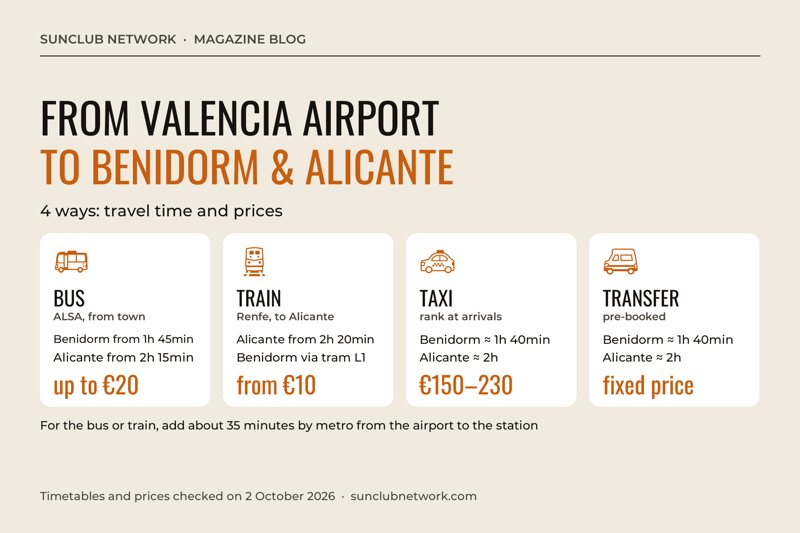
In the SunClub Business directory, Transfer VLC does these journeys. It is run by Maksym Medynskyi, husband of the publisher of our magazine, Iuliia Medynskaia. They range from a budget saloon to a 7-seat Mercedes V-Class, along the coast from Alicante to Barcelona. Usual routes and journey times are in our article on getting from Valencia airport to Benidorm and Alicante.
Schools and nurseries
As of 3 November nobody had announced that classes would be cancelled on 11 November. However, STEPV, CCOO and UGT are calling on state school teachers in our region to strike, and they have their own dispute with the authorities. A meeting on 3 November ended without agreement. The minimum staffing for schools has not yet been decided. The school may open, but your child’s teacher may not turn up.
Ask the head teacher or the class parents’ WhatsApp group who will be looking after the children and whether the canteen and school bus will run. Private schools decide for themselves, so it is worth contacting them early too. Arrange for a relative or neighbour to help in case you have to collect your child early.
Doctors and hospitals
Two strikes overlap here. Since 28 October doctors in our region have been on an indefinite strike. It was called by the Avanza union. Doctors are mainly out from Wednesday to Friday, and 11 November is a Wednesday. On the first day the union counted 29.6% on strike, the authorities 1.39%.
The Generalitat has already approved minimum services for the doctors’ strike, but as of 3 November there was no order for the general strike. In Catalonia, under a 2024 order, emergency departments, intensive care, dialysis, births, radiotherapy and chemotherapy kept running. For Valencia this is only an example so far. If you have a routine appointment or blood tests, ring your health centre (centro de salud) the day before. For emergencies, call 112 as usual.
If you are an employee
The right to strike also applies to people on temporary or part-time contracts or on probation. You do not have to tell your manager in advance, or answer the question “are you coming in?”. You cannot be dismissed or disciplined for taking part.
You will not be paid for the day, and the deduction is calculated pro rata and includes part of your bonuses, extra payments and rest days. Neither you nor the company pays Spanish social security (Seguridad Social) contributions for that day. Your contract is suspended for the day, but your length of service is not interrupted. Holiday days cannot be deducted. If 11 November is your day off, or you are on holiday or sick leave, the strike does not affect you and your pay stays the same.
There is one exception. If the company has officially put you on a minimum services shift, you must work. CCOO warns that you can be dismissed for not turning up. If you work from home, striking means not logging into the systems and not answering emails or calls.
You can also choose to work. If you are not striking but cannot get to work, lawyers at Cuatrecasas advise companies to let you work from home or keep paying you. That is only legal advice, so tell your manager in advance and keep proof that there was no transport.
If you run your own business
If you have staff, there are only a few things you cannot do. You cannot ask who will strike, put pressure on people or hire replacements. Lawyers at Cuatrecasas, citing Constitutional Court ruling 24/2026, warn that reprogramming automated systems just for that day to replace people is also questionable. The doors must stay open for those who come in. You record who turned up and deduct only the hours not worked. After the strike everyone returns to their job with no consequences.
Only informational pickets are legal. If someone threatens you or blocks the entrance, film it on your phone and call the police. What a shop owner should do if a street protest turns into rioting is covered in our article on the riots in Barcelona.
Strike law is written for employees. An autónomo (self-employed person) with no employer simply decides whether to open or not. There will be no takings on a day you close, and your monthly autónomo contribution stays the same. Let clients with appointments on 11 November know in advance, and check deliveries for 10–12 November: a supplier can get held up even if you are open.
What to check on 9 and 10 November
- The Renfe timetable on its website and any email or text about your ticket.
- The strikes page on the Generalitat website: this is where the minimum services orders are published (look for the words servicios mínimos).
- Messages from your school and health centre.
- Emails from your airline and the contact details in your booking.
- Your transfer confirmation, if you have booked one, and a departure time that leaves you plenty of margin.
- Where the demonstration starts in your town, on the CCOO and UGT websites.

Photo sources: flags by the bullring, the 2012 march and the tram in Alicante, licence CC BY-SA 2.0 (licence page in English), first image cropped. Estació del Nord, licence CC0.
Frequently asked questions
Has the general strike in Spain on 11 November been called off?
Not as of 3 November. The organisers are confirming it and holding meetings in towns and cities.
When was the last general strike in Spain?
The last time CCOO and UGT struck together across the whole country was on 14 November 2012. The strike of 14 December 1988 is considered the biggest.
Will there be a strike at the airport, and what about Ryanair flights?
As of 3 November we had found no cancellations from Aena or the airlines, and the ministry had not yet published a minimum timetable. Keep an eye on emails from your airline. On the strike day in November 2012, around 400 flights were cancelled across the country.
Will trains run on 11 November?
Some trains will run on a minimum timetable, but as of 3 November Renfe had not published the figures. Separately, there is a drivers’ strike on 10 November and partial stoppages on 12 November.
Will the TRAM to Benidorm run?
There is no answer yet. The minimum timetable usually comes out a few days before, so do not plan a journey that day without a backup.
How do I get from Benidorm to Alicante airport on the strike day?
On a normal day the ALSA bus goes there in about 45 minutes. We have not found its timetable for 11 November, so for an important flight it is better to book a transfer in advance.
Can a foreigner with a residence permit go on strike?
Yes, if you are an employee. CCOO’s guidance excludes only the armed forces, the security forces and serving judges from this right, and says nothing about nationality.
Do shops and cafés have to close?
No. The call not to buy anything is only a request from the organisers. Some places may close anyway if staff do not come in, so it is better to buy anything important in advance.
Will appointments at government offices be cancelled?
As of 3 November we had found no announcements of cancellations. If your appointment (cita previa) on 11 November matters, check it the day before by phone or on the office’s website.
This version of the article was translated from Russian with the help of AI.
SunClub Business directory
SunClub Business is the directory run by SunClub Network magazine: 240 businesses and professionals in Spain. The editors review every business page before it goes live. Browse the directory →
Add your business to the directory: a basic business page is free →