Magazine or Instagram: how to build a personal brand as an entrepreneur in Spain
One estate agent in Alicante has 15,000 followers. Another has 3,000 and a long interview in a magazine. Which would you trust with buying your flat? We look at what Instagram and a print magazine each do for an entrepreneur’s personal brand in Spain, what they cost and how one article can keep your social media going for months.
SunClub Network magazine and the SunClub Business directory mentioned here are published by our editorial team.

Picture two estate agents in Alicante. Both sell flats on the Costa Blanca, run an Instagram account, film sea views and explain where the better deals are. The first has 15,000 followers and posts stories every day. The second has 3,000 followers but has just been the subject of a long magazine interview. In it he talks about how he got into the business, the mistakes buyers make most often and how a Spanish property purchase differs from what they’re used to.
Which of them would you trust with buying a flat for €300,000? Everyone’s answer will be different, but follower numbers no longer look like the only thing that matters. A personal brand is made up of what people know about you before they become clients. Instagram helps you get noticed. A magazine article helps explain why people can trust you. So comparing the two only on price and views isn’t quite fair.
In this article
What Instagram gives you: speed and constant contact
Instagram’s great strength is speed. You film a Reel today and future clients watch it tomorrow. You launch an ad in the morning and the first messages arrive by evening.
That suits the owner of a new beauty salon in Valencia. She can show off the interior, introduce her team, post before-and-after results and run ads aimed at people in her part of town. She can experiment too: a design she doesn’t like can be changed in a minute, an offer that flops can be swapped for another, and she can move the budget around as the first results come in.
The downside is that Instagram wants you there every day. Yesterday’s Reel soon sinks in the feed, and stories disappear after a day unless you pin them to your profile. To stay in people’s minds you have to keep filming, writing, posting and answering comments. And a business owner who wanted to get on with the business suddenly notices that half the week goes on making content.
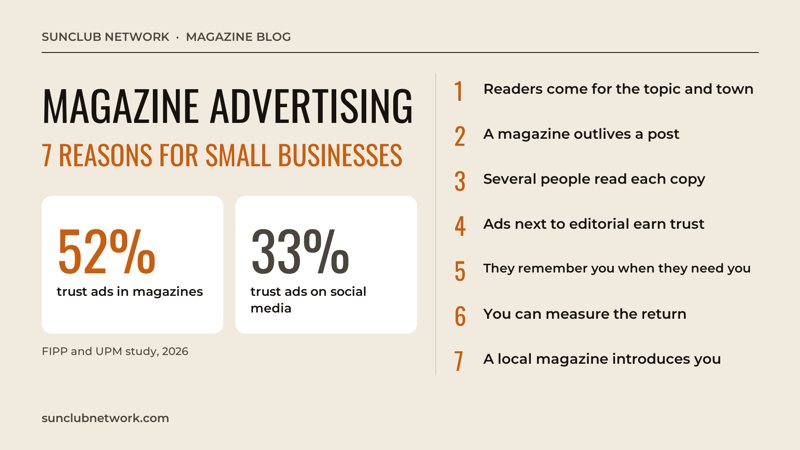
There’s another problem. A good-looking profile attracts attention, but trust in social media advertising is low. In a 2026 study by FIPP, the international association of magazine publishers, 33% of respondents trusted ads on social media and 28% trusted influencer ads. A client choosing a lawyer, a doctor or a financial adviser usually needs to know far more about the person than fits in a profile bio.
What a magazine gives you: a story and context
Now a different scene. You’ve arrived for a business meeting at a café in Valencia, the other person is running late and you’re leafing through a magazine about entrepreneurs and life in Spain. On one page there’s an interview with the owner of a construction firm. He talks about how he started out in a new country, where he got his fingers burnt in the first year, what kind of houses he builds now and the price per square metre.
Five minutes’ reading tells you more about him than a dozen of his ad posts. That’s the strength of the magazine format: behind the service, the reader sees a person with experience, opinions and a story of their own.
The article alone doesn’t prove the business is any good, especially if it’s been paid for. What convinces readers is the detail: figures, real projects, an honest account of mistakes. After a move abroad this counts for double. You have to rebuild your reputation in Spain from scratch, and people need to work out quickly who you are and why they can trust you.
What each format shows best
You can post long interviews on Instagram and run plain ads in a magazine, so the line between them is blurry. Still, each format nudges you towards its own way of talking to people.
Instagram is good for showing a process: a designer furnishing a flat, a beautician carrying out a treatment, a chef preparing a new dish. A magazine gives you room to tell more of the story. A psychologist in Benidorm can share tips in her stories every day, while a long interview about how she works with burnout in business owners shows her approach from another side. A restaurant owner in Alicante can skip yet another ad for the menu and talk about why he opened in that spot and where his grandmother’s recipes come from.
The more a client’s choice depends on the owner’s personality, the more sense this kind of story makes. The personal brand of a doctor, beautician, lawyer or psychologist gains more from an interview than a shop’s brand does.
What it costs: Instagram ads or a magazine feature
On Instagram you can start on a small budget and raise it as results come in. A magazine has a fixed price that depends on the format, the print run and the position in the issue. In SunClub Network a full page costs €335 and a double-page spread from €590, including VAT (IVA). The magazine is printed in Russian and Ukrainian, with one exception: No. 7, out in March 2027, is a special issue written entirely in Spanish. We went through the formats and how to work out the return in our piece on magazine advertising.
A magazine article needs planning. You have to give the interview, have photos taken, approve the layout and wait for the issue, and ours comes out once a quarter. If a restaurant needs to fill its tables this Friday, social media ads will do the job better. If the same restaurant wants to introduce the town to its chef and his cooking, a magazine takes longer and goes deeper.
The same FIPP study has a figure for new businesses: 54% of magazine readers are more likely to buy an unfamiliar brand they saw in a magazine than one they saw on social media. If nobody has heard of you yet, that’s worth thinking about.
Instagram and a print magazine side by side
| What we’re comparing | Print magazine | |
|---|---|---|
| How fast you can start | The same day | You wait for the next issue |
| Who sees it | Whoever the algorithm picks based on your ad settings | People interested in the subject, in the region where it’s handed out |
| How to measure results | Detailed stats in the app | QR codes, promo codes, asking “how did you hear about us?” |
| How long it lasts | A post a day or two, stories 24 hours | Each issue stays in venues until the next one |
| What it does for your personal brand | Regular contact, video, your work in progress | A long interview, your story, how you’re seen |
| Budget | Any amount, and you can change it every day | A fixed price per format |
A million views don’t equal a million clients, and a handsome magazine doesn’t sell anything on its own either. The result depends on what you say and who you say it to.
Why a local magazine is worth a look for businesses in Spain
Imagine a lawyer who has moved from Ukraine to Valencia and opened a practice. On Instagram he’s competing for attention with thousands of experts and influencers from around the world. A magazine about life and business in the region is read by people with similar things to sort out: buying a home, dealing with paperwork, registering as autónomo (self-employed), choosing a school for the children, finding a doctor.
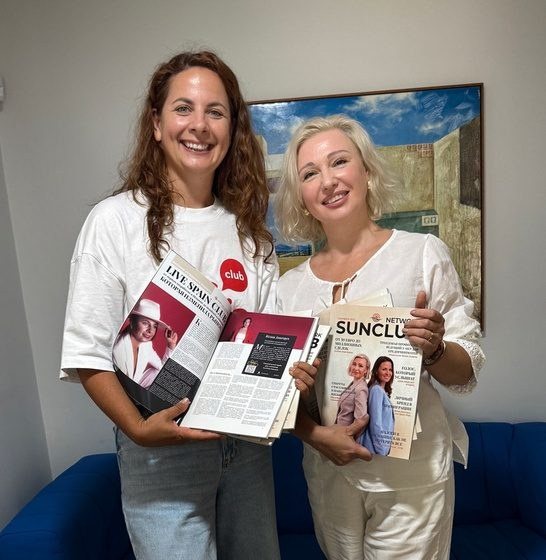
Where a magazine is distributed matters. People pick up ours free of charge in cafés, clinics, salons and coworking spaces from Valencia to Alicante, and it’s handed out at business meetings. Before you book space in any publication, ask where people get it, how many copies are printed and who reads it. For a dental practice in Valencia, ten patients from its own city matter more than a thousand random views from other countries.
How one article can feed your Instagram for months
Many people treat a magazine article as a one-off purchase. The issue comes out, they post a photo of the cover and forget about it. A good article can keep working for much longer. An entrepreneur who has given an interview can:
- post a photo with the magazine and a link to the online version of the article
- film a Reel about how the interview and the shoot went
- make a carousel from the main ideas in the article
- tell the story of her business bit by bit in stories
- add the feature to her portfolio, presentation and sales proposal
So one magazine article gives your Instagram material for months ahead. Articles from SunClub Network issues also appear on the magazine’s website, and the featured person’s business page in the SunClub Business directory links to their interview. The online version won’t by itself guarantee a high Google ranking or a place in ChatGPT’s answers. That takes separate work, which we covered in our piece on how to get ChatGPT to recommend your business.
How to tell whether a feature has worked
With Instagram it’s all familiar: reach, clicks, cost per enquiry. With a magazine it’s harder, but some of the results can be measured. An estate agency puts a QR code on its page that leads to a selection of flats on the Costa Blanca. A restaurant offers something on the house to anyone who comes in with the magazine page, and a consultant invites readers to a free first meeting. An expert who cares more about reputation watches for new enquiries and for how often people say “I read your interview” at meetings.
Don’t credit all your sales growth to one article. A client may have seen you on Instagram, read the article and heard a recommendation from a friend all in the same month, so judge your channels together.
Which should an entrepreneur in Spain choose?
It all depends on the job in hand. You’ve opened a coffee shop in Alicante and want the neighbourhood to know about your discounted breakfasts: go for Instagram. You show new flats every week: Instagram again.
If you’re growing an estate agency, a law practice, a clinic or a consultancy and want to be known as a specialist, back up your Instagram with articles in magazines that cover your niche and region. This matters most when you want clients and partners to understand who you are and what sets you apart from others in your market.
The channels work best together. On Instagram you talk to your followers every day, and in a magazine you tell your whole story. Your website and business page are there for anyone who’s interested and wants to find out more about you.
Frequently asked questions
Which is better for promoting a business: Instagram or a magazine?
For quick enquiries and special offers, Instagram. For trust and reputation, especially for doctors, lawyers, estate agents and consultants, a magazine interview works harder. The best results usually come from using both.
How do I build a personal brand from scratch after moving to Spain?
Start with an Instagram account that makes clear what you do and a business page with reviews, so there’s something to find when people look you up. Then add the things that build trust from outside: an interview in a local magazine, speaking at networking events, recommendations from clients.
How do I build a personal brand on Instagram?
Show your face and your work: the process, results, reviews, answers to the questions clients often ask. Post regularly and, above all, gather the best of it in story highlights, so that someone new can see who you are in a minute.
How much does a magazine article cost in Spain?
It depends on the publication. In SunClub Network a full page costs €335 and a double-page spread from €590, including IVA. The editorial team prepares the text and layout.
How can I use a magazine article on Instagram?
Post a photo with the magazine, film a Reel about the shoot, make a carousel from the main ideas and put a link to the online version in your profile bio. One article gives you enough for months of posts.
Tell your story in the magazine
At SunClub Network we write about people building businesses in Spain: how they started, what went wrong and what sets them apart. If you’d like to tell your story, message the editorial team on WhatsApp and we’ll suggest a format.
This version of the article was translated from Russian with the help of AI.
SunClub Business directory
Professionals in this field in the SunClub Business directory
 Live Spain ClubMedia about life in Spain: a YouTube channel with 44 thousand subscribers and an Instagram account with 20 thousand. Interviews, reviews and advertising for businesses and experts.Alicante · Russian, Ukrainian, Spanish, English
 Palette ProductionVideo content production for companies and estate agents, plus content strategy development and delivery.Valencia · Russian, Ukrainian, Spanish, English, Belarusian
 Viktor ShevchenkoMarketing, Google Business, YouTube, analytics and automation for businesses and educational projects.Russian, Ukrainian, Spanish, English
SunClub Business is the directory run by SunClub Network magazine: 240 businesses and professionals in Spain. The editors review every business page before it goes live. Browse the directory →
Add your business to the directory: a basic business page is free →
 Magazine advertising: seven reasons it works for small businesses in Spain
 Personal branding for entrepreneurs in Spain: why an expert needs a magazine, a podcast and social media
 How to promote your business locally in Spain: social media, live events and a print magazine
 How to build a personal brand in Spain: an interview with Yulia Repetskaya