Musk's Prediction: Work Will Become Optional. What It Means for Business Owners in Spain
A year ago, Elon Musk said that in 10 or 20 years work would become optional. We compared his prediction with the new INE figures on how many companies in Spain already use AI, and looked at which jobs AI will replace, which it will not, and what a small business can do now.

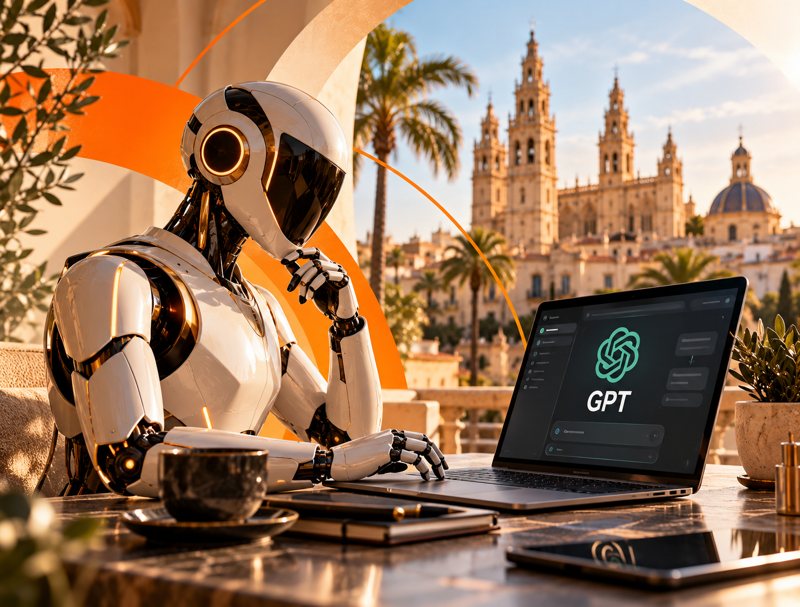
“My prediction: work will be optional.” Elon Musk said this on 19 November 2025 at the US-Saudi investment forum in Washington. As he put it, work will eventually look like a sport or a video game: those who want to do it will. He was cautious about the timeframe: “maybe 10 or 20 years”.
The prediction spread across social media and, a year on, still turns up in feeds. We have also been asked what it means for a small business. Let's take it step by step. What exactly did Musk say? Which jobs is AI already taking over, and which will it not replace? And what should a business in Spain do now, without waiting for 2045?
In this article
What Elon Musk said about the future of work
At the forum in Washington, Musk illustrated his idea with vegetables. You can buy them in a shop or grow them in your own garden. Today people keep a vegetable patch because they enjoy it, not because they are hungry. Work will go the same way, Musk believes: AI and robots will take care of everything that is needed, and people will work if they want to. His words are reported by Fox Business.
He also said that “at some point money will stop mattering” and that AI and humanoid robots will “end poverty”. He added that a lot of work was still needed to get there. How people will live without a salary, Musk did not explain.
At the end of November 2025, Musk repeated the prediction on the podcast hosted by the Indian businessman Nikhil Kamath, and even shortened the timeframe: “less than 20 years”, or perhaps 10 or 15. This is reported by Teslarati. The idea is not new for him. In May 2024, at the VivaTech conference in Paris, Musk said: “Probably none of us will have a job.” He put the likelihood of such a future at about 80% and immediately asked the central question: if a computer and robots do everything better than you, what is the point of your life? The talk was reported by CNN.
Universal high income and universal basic income
At VivaTech, Musk also answered the question of what people will live on. He spoke of a “universal high income” and stressed that he did not mean a basic one. Universal basic income is a modest sum that the state pays to everyone to cover the essentials. Economists have argued about it for a long time, and Finland tested such a payment in 2017 and 2018 on two thousand unemployed people. High income in Musk's version means something different: goods and services will become so plentiful that there will be enough for everyone. Where the money will come from and who will share it out, he did not say.
Spain has had the Ingreso Mínimo Vital, a minimum living income, since 2020. It is a benefit for low-income families: it is granted on application, and the income of the whole household is checked. Spain has no universal basic income, let alone a universal high one, so for the years ahead we will go on earning a living the old way.
How many companies in Spain already work with AI
While Musk talks about the 2040s, Spanish businesses are trying out AI right now. According to the National Statistics Institute (INE), whose figures were published on 22 October 2026, AI was used in the first quarter of 2026 by 33.6% of companies with 10 or more employees. Among microbusinesses, with fewer than ten staff, the figure was 21.4%. A year earlier the figure for microbusinesses was 13.4%, so within a year it has grown by more than half.
According to Eurostat, in 2025 one in five EU companies with 10 or more employees used AI, and Spain was roughly level with Europe. If you haven't tried AI in your work yet, you are not behind most businesses. Yet one in five small businesses in Spain is already trying it.
Which jobs AI will replace
It is more accurate to talk about tasks than jobs. AI is quickly taking over work that is done at a computer and follows a clear pattern: simple translation, answers to routine customer questions, drafts of letters and contracts, product descriptions, transcribing recordings, a first read of paperwork. Where a job consists entirely of such tasks, fewer people will be needed.
For a small business in Spain this means, above all, saved evenings. If you have no secretary, a bot can answer on WhatsApp at night and tell customers what your service costs. AI can help an estate agent write a letter in Spanish to the building's community administrator (administrador de fincas). A salon owner can get a text about a new service in four languages within five minutes. Before, you would have had to hire an assistant or sit up late yourself.
We work this way in our own editorial team too. AI helps us transcribe interviews and prepare translations of articles into Spanish, Ukrainian and English. What goes into the magazine is decided by people.
Which jobs AI will not replace
The first thing AI will not replace is skilled hands and personal presence. The jobs that will last longest are those where the client pays for exactly that. You can't get a haircut, a manicure, a massage or dental treatment over chat. Robot hairdressers in every district of Valencia are a very long way off.
The second thing it will not replace is trust. People choose a gestor (an adviser who deals with the Spanish authorities on your behalf), an estate agent or a psychologist because friends recommended them, because they saw the person at an event or read about them. An AI tool can suggest a name, but the client trusts the person who answers for the result. A gestor files your return with Hacienda, the tax office, and answers to you for mistakes. With software, there is nobody to hold to account.
The third, and for Spain the main one, is language and local experience. A client who speaks Russian or Ukrainian needs a specialist who will explain Spanish rules in that language and knows how things work in practice in Valencia or Alicante. AI can translate a law, but it won't tell you which ayuntamiento (town hall) offers earlier appointments or what they will actually ask you to bring.
That is why lists of jobs AI will not replace usually include craftspeople and beauty professionals, doctors, teachers, psychologists, event organisers and everyone who works with people in person. It reads almost like a description of our SunClub Business directory.
What a business owner in Spain can do right now
There is no need to wait 20 years, and no need to quit your business over a forecast. Start simply: for a week, note down where your time goes. A lot of routine usually turns up: answers to the same questions, invoices, correspondence with Spanish authorities, posts. Those are the first tasks to hand over to AI.
Use AI to write in Spanish, but check the result. A letter to the council, a reply to a landlord, website copy: an AI tool will draft them in a minute. Figures for the tax office, contract terms and anything you sign should be checked with a gestor or a lawyer. You are responsible for the document. The software is not.
If you put a bot on your website or WhatsApp, tell the client straight away that they are talking to a bot. It is more honest, and the European AI Act also requires people to know that they are dealing with AI.
Make sure AI chatbots can find you. Clients are already asking ChatGPT whom to go to in Valencia. We explained in detail how to appear in such answers in our article on promotion in AI chatbots.
And invest in what AI won't do for you: personal contact. Public speaking, meetings, professional networking and a personal brand all build trust. The more generated text and imagery there is around us, the more a person who is known face to face is worth.

Frequently asked questions
What did Elon Musk say about the future of work?
On 19 November 2025, at the US-Saudi investment forum in Washington, Musk said that in 10 or 20 years work will become optional, like a sport or a video game. AI and robots will produce everything that is needed, and people will work if they want to.
Which jobs will AI not replace?
Those that need hands and personal presence: beauty professionals, doctors, massage therapists, cooks. Those where the client chooses a person out of trust: gestors, estate agents, psychologists, teachers. And those where local experience and the client's language matter.
Which jobs will AI replace in the next 10 years?
The biggest change will come to computer work that follows a pattern: simple translation, routine answers to customers, data entry, drafts of documents, product descriptions. Usually, a job does not disappear entirely. The same tasks simply need fewer people.
How does universal high income differ from universal basic income?
Basic income is a modest payment from the state to everyone to cover the essentials. By universal high income Musk means a future in which, thanks to AI and robots, there are enough goods and services for everyone. How it would work, he did not explain.
How many companies in Spain use AI?
According to INE data for the first quarter of 2026, AI was used by 33.6% of companies with 10 or more employees and 21.4% of companies with fewer than ten.
Where should a small business start?
Note down where your time goes over a week and hand the repetitive tasks to AI: answers to routine questions, drafts of emails in Spanish, descriptions of services. Anything you sign or file with the tax office, check with a gestor.
This version of the article was translated from Russian with the help of AI.
SunClub Business directory
Professionals in this field in the SunClub Business directory
 Viktor ShevchenkoMarketing, Google Business, YouTube, analytics and automation for businesses and educational projects.Russian, Ukrainian, Spanish, English
 Live Spain ClubMedia about life in Spain: a YouTube channel with 44 thousand subscribers and an Instagram account with 20 thousand. Interviews, reviews and advertising for businesses and experts.Alicante · Russian, Ukrainian, Spanish, English
SunClub Business is the directory run by SunClub Network magazine: 240 businesses and professionals in Spain. The editors review every business page before it goes live. Business & Consulting in the directory: 13 →
Add your business to the directory: a basic business page is free →