Autónomo or SL, tax and partnership agreements: advice from a lawyer in Spain
Lawyer Igor Lapchynskyi says most clients come to him after the deadlines have already passed. He explains why it pays to set up an SL (a Spanish limited company) rather than stay autónomo (self-employed) once your income grows, why a dispute with the tax office is risky, and what a partnership agreement and a trademark registration in Spain and the EU cost.
Partner content. Prices and terms as of the publication date.
Legal services in the SunClub Business directory: contacts and prices →

“60% of clients come to us when it’s already hard to change anything.” Igor Lapchynskyi talks about tax, business partnerships, trademarks and real cases his firm has handled.
Igor, do clients often come to you too late?
Sadly, that’s the norm. It’s roughly 60/40. Most people come when it’s already too late, and fewer come while the problem can still be prevented. Spain is very strict about deadlines. Miss one and your options shrink fast. You can appeal or write a letter, but the outcome won’t be the same. We work with the situation as it stands.
In this article
Three cases: an inheritance, unpaid wages, a humanitarian residence permit
Tell us about some cases that have really stayed with you.
One was a widow. Her husband’s daughter cut her out of the inheritance. Under Catalan civil law a widow is entitled to what’s called the cuarta vidual, up to a quarter of the whole estate, if her standard of living fell after her husband’s death. We took it to court and won. She was paid everything she was owed and she got a survivor’s pension. That’s the kind of moment when you know you’re doing something right.
The second was a construction worker. A classic story: he was promised his pay and nobody paid him. We went to court and won him compensation, and on top of that every day he had worked was restored in his social security record. That’s his contribution history, which means real money later on.
And the third is one of the most memorable. When I was just starting out, a family came to us. Their child had cancer. They had arrived with no money at all. We got them a humanitarian residence permit and didn’t charge a single cent. The child recovered in Spain. He still drops by the office now and then. That’s what you do this work for.
Autónomo or SL: which works out better
Let’s talk tax. Is it better to be autónomo or to set up an SL?
No question. Once you reach a decent income, especially if you start taking on staff, stop being autónomo and set up an SL.
An autónomo has unlimited personal liability to creditors, the tax office and social security. If something goes wrong, everything you own personally is at risk. In a company, liability is limited to the share capital. That’s a fundamental difference.
On tax: an autónomo pays on a progressive scale from 19% to 47%, and in Valencia the top rate is around 54%. In other words, the more you earn, the more you hand over. A new company pays 15% corporation tax for its first two years in profit. After that, in 2026, it pays 19% on the first €50,000 of profit and 21% on the rest if turnover is under €1 million, 23% with turnover up to €10 million, and 25% otherwise. And there are two ways to take the profit out. One is a salary: the same progressive scale, but it counts as an expense and lowers the corporation tax. The other is dividends, taxed at 19, 21, 23, 27 or 30% depending on the amount. In most cases salary plus dividends works out better than being autónomo. My general advice for Spain is to keep as much as you can in the company. The car, the property, put it all in the company’s name. Being a wealthy private individual doesn’t pay here. That’s the logic of the tax system, and Spain didn’t invent it.
Wealth tax and disputes with the tax office
And wealth tax, the Impuesto sobre el Patrimonio, is that real?
Yes, it exists. How much you pay depends on the region. Madrid doesn’t have it, for political reasons, although anyone worth over €3 million pays the state solidarity tax on large fortunes there. Valencia does. That’s something else to weigh up when you choose a region to register a business or buy property.
You mentioned that it’s better not to go to war with the tax office.
It’s one of the most important things I tell clients. In tax law there’s no presumption of innocence, the way there is in criminal law. Hacienda opens a case, works out a sum, and it’s up to you to prove they’re wrong. You can prove whatever you like and they’ll say “no”. Then the tax tribunal (Tribunal Económico-Administrativo) says “no” as well. Only after six or seven years do you get to court (in Shakira’s case, the Audiencia Nacional), and only there are you on an equal footing.
I know people who lost everything to the tax office, their home and their business. One wrong step. So when Hacienda offers “Pay now with a 30% discount, but sign to say you agree”, a lot of people accept. And it’s often the right call, because the alternative is years in court, and you still have to win.
Partnership agreements and registering a trademark
What’s the right way to set up a business partnership legally?
This is probably the most important advice for anyone going into business with someone else. Sign a partnership agreement that spells out absolutely everything: the rules for selling a share, the rules for leaving the partnership, who does what and who has the authority to decide what. Most people go into business on trust, and that’s exactly why they later spend a fortune on lawyers when something goes wrong. I’ve seen it first-hand. At a company where I used to work there were two partners, 50/50, a big business. A dispute broke out. Lawyers were hiring lawyers. They split up the clients, the office, the profits, the staff. In the end they settled, but it cost them a fortune. There was one reason for all of it: nobody had written down the rules of the game. Another case was a young pastry chef and an investor. He put in the money, she put in the product and the work. They fell out. Part of the money had been paid in cash. How do you split it? How do you prove anything? It all turned into chaos.
A partnership agreement is your constitution. It starts at €250. Set that against what it costs you not to have one and the sums aren’t even close.
Do you need to register a trademark?
Definitely, and as early as possible. The principle is simple: whoever registers first owns it. Someone can spot your brand, register it in their own name and then send you a demand to pay for using your own name. This really happens. As soon as I set up my company I registered three brands. One was under my own surname, because I knew that if the company ever changed its name for whatever reason, a brand with my surname would always stay mine. Registering a trademark in Spain costs around €450 plus IVA (Spanish VAT), plus an official fee of €127.88 if you apply online. It takes anywhere from nine months to a year and a half. If you want protection across Europe, it’s €750 plus IVA, plus €850 in official fees online, plus €50 for the second class of goods or services and €150 for each class after that. But that covers 27 EU countries and lasts 10 years.
How not to burn out, and why reputation matters
I know you do dozens of consultations a day, which is a lot. How do you recover from that kind of workload?
Two things. The first is the gym in the morning. I start my day between 06:00 and 06:30. After work I can’t make myself go, so it has to be mornings. It helps me leave the stress there and start the day in a different frame of mind.
The second is that I’m learning to switch off at weekends. That didn’t come straight away. Sometimes it doesn’t work. There are three kinds of call I always take on a Saturday or Sunday: extradition, arrests and serious family conflicts. Everything else goes to colleagues. If you don’t switch off, you burn out very quickly. When you take every client’s problem to heart, it’s emotionally hard.
These days I hardly handle cases myself. I organise and oversee the work and do some of the consultations. The work is shared out among specialists, because with this volume it’s physically impossible to do everything yourself.
Last question: what’s your main advice for entrepreneurs in Spain?
Look after your reputation. When I work with people, decency comes first for me, and professionalism second. We want each client to solve their problem, come back and recommend us to their friends. Making money from someone once and never seeing them again is not how we work.
You may live in a big city, but believe me, it’s very small. Everyone knows everything. If someone does something bad, the next day everyone knows about it. Reputation is the only asset you can’t buy and can very easily lose.
Updated 1 November 2026: rates and fees brought in line with 2026 figures.

This version of the article was translated from Russian with the help of AI.
SunClub Business directory

Legal services
Professional legal services in Spain. Arranging and renewing all types of residence permits
- Languages
- Russian, Ukrainian, Spanish, English
SunClub Business is the directory run by SunClub Network magazine: 240 businesses and professionals in Spain. The editors review every business page before it goes live. Browse the directory →
 Spain’s minimum wage: €1,221 now, €1,286 proposed for 2027. What it means for autónomos
 Outlook down? What to do when Microsoft 365 fails, and whether you’re owed compensation
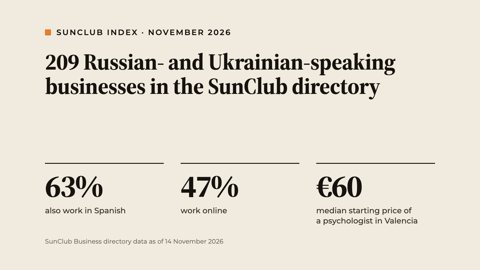 Russian- and Ukrainian-speaking businesses in Spain: SunClub Index, November 2026
 Is a beauty salon a good business in Spain? Lessons from Tonya Khudaya, owner of two NOVA Beauty Club salons