Staff training or a business game: what to choose for your team
A sales training course, a team outing to an escape room or a business game? The manager of a small team has to decide how to spend an evening and the budget. We look at where training works better than a game, where it is the other way round, and what research says about it. We run the Universe of Business game ourselves, so we also write about what it cannot do.
The Universe of Business game was created and is run by the founders of SunClub Network magazine, Bjarka Elena Kisiura and Iuliia Medynskaia. The SunClub Business directory, where the game has its own page, is also a project of our editorial team.

Many people are sure that only 10% of what a training course teaches is still used at work afterwards. J. Kevin Ford, Stephen Yelon and Abigail Billington traced where this figure came from, found no measurements behind it and called it “the 10% delusion” (Performance Improvement Quarterly, 2011). When training specialists from 150 companies were asked directly, the figures came out higher. Straight after a session, 62% of employees apply what they learned, 44% after six months and 34% after a year (Alan Saks and Monica Belcourt, Human Resource Management, 2006). How much people apply is most closely linked to what happens in the company before and after the training, and less closely to the session itself.
Training does work, though. Winfred Arthur and colleagues pooled hundreds of measurements from studies of training in companies (Journal of Applied Psychology, 2003). They found a medium to large effect: after training, people know more and work differently. So the choice comes down to the task, to what your particular team is missing.
Bjarka Elena Kisiura and I run the business game Universe of Business for teams ourselves, so we have a stake in this comparison. The game is played only in Russian. We write in just as much detail about the cases where a game loses out to training.
In this article
In short: what to choose for your team
- People cannot do something specific: follow a script with a client, use a new booking system, process a refund. You need training with hands-on practice.
- They have the skills, but the team is stuck: sales have dropped and nobody speaks at meetings, roles got muddled when new people joined, a decision has been put off for months. Here a game helps more. The team needs to say out loud what is going on and agree on a first step.
- You need both. Learning games achieve more alongside other training and are weaker on their own. That is what Traci Sitzmann’s meta-analysis found (more on it below).
When your staff need training
Training is needed when a task has a right answer and that answer can be shown. A clinic receptionist is moving to a new booking system. Salon staff all have to offer aftercare using the same script. A manager is learning to give discounts without making a loss. The trainer demonstrates, and people repeat it until they get it right. A week later you can see whether they can do it or not.
Skills like these have an advantage: they carry over to the job more easily. Brian Blume and colleagues reviewed 89 studies (Journal of Management, 2010). For “closed” skills, such as using a piece of software, results depended less on people’s attitude and the atmosphere in the team than for “open” skills such as leadership.
This is where a game loses out. Traci Sitzmann pooled 65 studies of simulation games for learning, with 6,476 people taking part (Personnel Psychology, 2011). When, instead of a game, people took a course that also kept them hands-on the whole time, they knew more afterwards than those who had played the game.
Before you pay, ask the trainer how much of the session will be hands-on and how they will check the skill a month later.
When a business game for staff works better than training
Sometimes everyone has the skills and still nothing changes. Sales have dropped, but nobody mentions it at the team meeting. New people have joined, and it is no longer clear who is responsible for what. A decision on prices has been put off since spring. Every brainstorm produces the same ideas. Training will not do much here, because it is unclear which skill to teach.
First, people need to say out loud what is going on. Ask directly “what’s wrong with our sales?” and people get guarded and give the expected answer. In the game, they draw a picture card and name the first thing that comes to mind. Then they explain, in their own words, how it connects to their work. That way the conversation gets to what really worries them. The facilitator does not interpret the cards or judge the answers.

There is data on the value of team sessions too. In 2009 Cameron Klein, Eduardo Salas and colleagues tested whether team building works (Small Group Research). It does, with a medium effect, and it is strongest on how people relate to each other and how they work together. They divided team building into four parts: goal setting, relationships, problem solving and role clarification.
The Star Crew station in our game has tasks on exactly that: roles and shared decisions. The team builds an imaginary space station and decides who is the engineer, who is the architect and who looks after supplies. It saves a damaged ship by reaching a decision together. It writes three rules for the team and says honestly which one gets broken most often. After each task there is a short round of discussion: what did this show about our real team?

Sitzmann also has good figures on games. After learning through a simulation game, people’s confidence in their own abilities was 20% higher than in the comparison group. Factual knowledge was 11% higher, the ability to apply knowledge 14% higher, and some time later they remembered 9% more. There are two caveats. Sitzmann studied computer simulations, and there are no board games in her sample. And she herself found a bias in this field: studies with good results are published more readily, so the figures are probably inflated.
Training vs a business game: a comparison
| Training | Game | |
|---|---|---|
| Goal | teach a skill | find where we are stuck |
| Who talks | the trainer | the team |
| Answer | one right answer | everyone has their own |
| Result | people can do it | steps with dates |
| Check | test, sign-off | a question a week later |
| Good for | scripts, till, CRM | roles, prices, decisions |
| Risk | forgotten without practice | will not teach a skill |
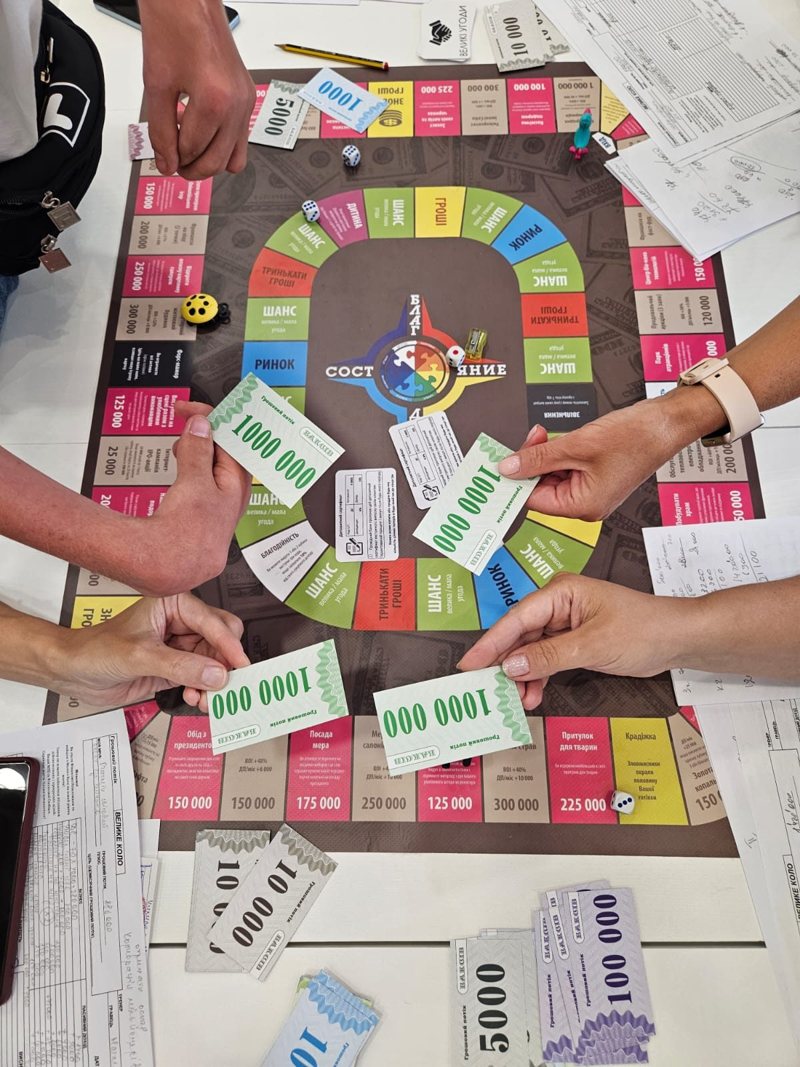
Some games do teach a skill. Robert Kiyosaki’s Cashflow, a board game about money, works exactly like that: each player keeps their own financial statement and works out how much money comes in and goes out. In Valencia it is run by Natalia Stuchinskaya, and we have written about how a Cashflow game works.
How a Universe of Business game for a team works
Before the game, we meet the manager. We ask why the team needs a game: team spirit, communication, new ideas, a plan, tiredness. We ask what is happening right now: new people, changes, tension between colleagues. And together we decide whether the manager will play. If they do, they play as an equal. People open up less when the manager is there, so sometimes the game is more useful without them.
We narrow the board down to fit the answer. It has twelve stations, and the most common requests have their own:
| Manager’s request | Station |
|---|---|
| Cohesion, roles, how we talk | Star Crew |
| Sales and prices | Star Treasury |
| Clients we have not reached | New Galaxies |
| New ideas | Supernova Idea and Cosmic Mind |
| Plans and decisions | Space Navigation |
| Tiredness and burnout | Cosmic Harmony |
The game itself takes three hours. Four to six people sit at the table, plus a facilitator. In the first 40–50 minutes each player puts into words what they want to work on and scores their work on a wheel of twelve areas. Then comes an hour and a half of moves: a twelve-sided die picks the station, and each move takes 5–7 minutes. The last 30–40 minutes go on the finale and the debrief. If time is short, we cut a round of moves and leave the finale as it is.

Each move ends with one step written in the ship’s log. We do not accept a step without a date. “Think about prices” does not count as a step, “raise the price of a consultation from Monday” does. For each entry the player lights a star, and by the finale everyone has a list of steps with dates.
There is research behind the date in the log. Peter Gollwitzer and Paschal Sheeran pooled 94 tests (Advances in Experimental Social Psychology, 2006). People who decided in advance when, where and how they would take a step reached their goal noticeably more often than those who only had an intention. By the standards of psychology, that is an effect between medium and large.
After the game, the manager receives a report: which topics came up most often, where the team is strong, which areas for growth are visible and which steps the team has planned. The report contains no names, quotes or personal details. The game is not a staff assessment, and everyone knows this from the first minute. A week later we ask each person how their first step is going.
This is where Saks and Belcourt come in again. According to their data, companies do the most to help skills carry over to the job during the session itself, and noticeably less before and after it. Yet it is what happens before and after that is more closely linked to the result.
During the game the rules are simple. Nobody judges the answers, any question can be skipped, and you can pause at any moment. Personal matters, money and family stay out of the group discussion: the player works on them silently in the log. There is nothing mystical about it. The cards and dice help people focus, and each mechanic has a simple psychological explanation.
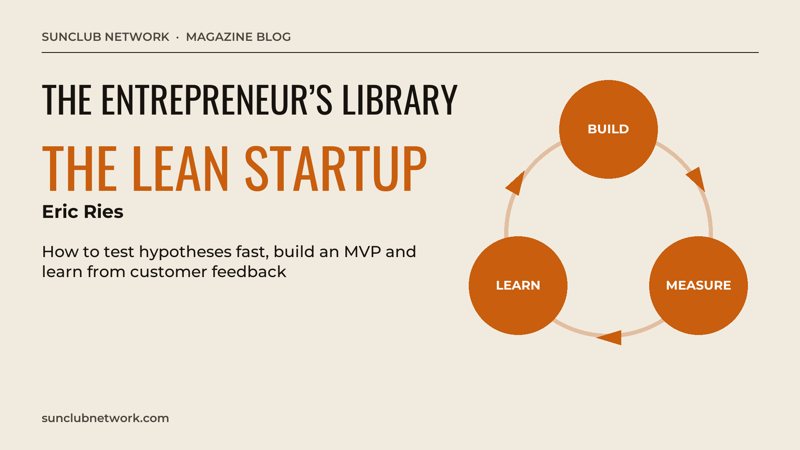
If you do not have a team yet and are just starting your business, you can play one to one with a facilitator, which takes about two hours. We wrote about testing an idea in small steps in our review of Eric Ries’s book The Lean Startup.
What a business game will not do
A game will not teach anyone to use software, sell to a script or work out a mark-up. For that you need training or practice alongside someone who already knows how.
Nor will a game resolve an open conflict between two employees. If a personal argument starts at the table, the facilitator stops the game, calls a break and talks to each person separately.
A game is not therapy. It works with the goals and decisions of healthy adults. If an employee has severe burnout or is grieving, they need a specialist. The facilitator will not go into it at the table and will talk to the person privately after the game.
And one evening does not change a team for good. That is why the game has the wheel: at the start each person rates their own, and in the finale they compare “before” and “after”. A repeat game a couple of months later shows what has changed in that time.
Four questions to ask before you book
- Can you write down what a person should be able to do after the session and check it a week later? If so, you need training.
- Do your people lack the skills, or do they keep quiet? If they have the skills but keep quiet, there is nothing to teach them. They need to talk it through and agree.
- Does the task have one right answer? A discounted price can be calculated correctly. Who looks after a client after the sale is something only the team itself can decide.
- Who will ask a week later what has changed? If nobody, neither training nor a game will help. That is also what the Saks and Belcourt figures from the start of this piece show.
If your answers point to a game, message me on WhatsApp with how many of you there are and what you expect from the game. Please note that the game is played only in Russian. There is an “Ask about the game” button on the game’s business page in the SunClub Business directory. Managers will find more details on the “Business game for teams” page (in Russian). And if you would like to run games like this yourself, we also train facilitators: how to become a facilitator of transformational games.
Frequently asked questions
What is the difference between a business game and training?
Training teaches a skill that has a right answer: a sales script, a piece of software, a calculation. In a business game, the team talks about its own work and agrees on steps: who is responsible for what, why sales have dropped, what decision to take. In Universe of Business, every move ends with a step and a date.
Training vs team building: which is better for a team?
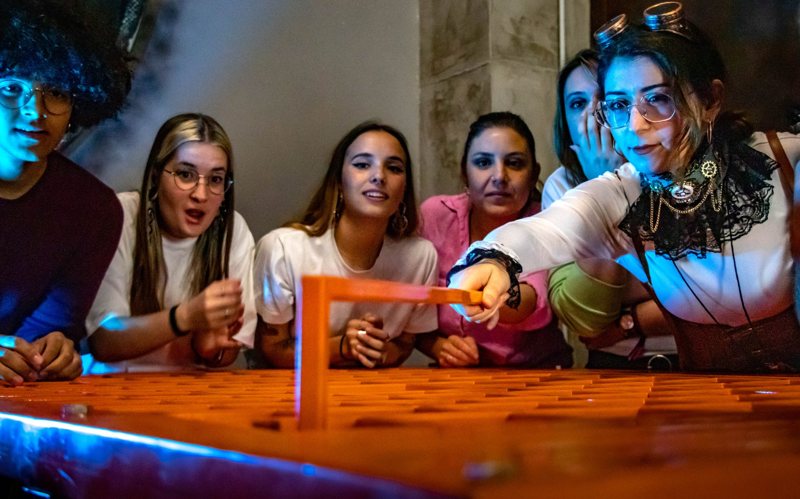
It depends on the task. A treasure hunt, an escape room or a paella on the beach brings people closer outside work. Training teaches a skill. A business game also brings people closer, but the conversation there is about work: prices, clients and roles in the team. According to the meta-analysis by Klein and colleagues (2009), team building on average improves relationships in a team and the way it works together.
How long does a business game for staff take?
Three hours: the first 40–50 minutes for players to say what they want to work on, an hour and a half of moves around the stations, and 30–40 minutes for the finale and debrief. Before the game there is a separate meeting with the manager.
How many people can play?
Four to six people and a facilitator at one table. An entrepreneur without a team can play one to one with a facilitator. Our largest game was online, with 300 participants.
Should the manager play with the team?
We decide together at the meeting before the game. If the manager plays, they play as an equal. People open up less when the manager is there, so sometimes the game is more useful without them.
What will the manager learn about the staff?
Only team-level topics: what came up most often, where the team is strong, which steps it has planned. No names, quotes or personal details. The game is not a staff appraisal tool.
What language is Universe of Business played in?
Only in Russian. We play in person or online.
How much does a game for a team cost?
We run each game on request. The price depends on the number of participants and includes the meeting with the manager before the game and the report afterwards.
Isn’t this all a bit mystical?
No. The cards and dice help people focus. Each mechanic has a simple psychological explanation: projection, Kolb’s experiential learning cycle and writing down a step with a date.
This version of the article was translated from Russian with the help of AI.
SunClub Business directory

Universe of Business
A business game for teams and entrepreneurs: team building, training and a review of your own business. At the end, everyone leaves with a list of steps and dates.
- Where
- Valencia
- Languages
- Russian
SunClub Business is the directory run by SunClub Network magazine: 240 businesses and professionals in Spain. The editors review every business page before it goes live. Browse the directory →